
About F.M. Alexander
Frederick Matthias Alexander (1869-1955) was a Shakespearean reciter from Australia. At a fairly young age, F.M., as he came to be known over time, would lose his voice on stage, although he was able to use it in everyday life. He was advised by doctors to rest his voice between his acting engagements as they could not find any specific cause for his problem; however, as the issue continued even after he followed their advice, he reasoned that perhaps the way in which he ‘used’ himself while performing was the root of his problems.
What is ‘use’?
Alexander embarked on a long process of self-study and ultimately arrived at what is now known globally as the Alexander Technique. He used mirrors to observe himself while reciting. In time, he noticed he had a habit of pulling his head back and down when he spoke, and further, that even the thought of speaking was a big enough stimulus to result in this habitual response. Additionally, as his head was retracted, he noticed the tendency to depress his larynx, lift his chest, and build up associated tensions in other areas. Based on this, his hypothesis was that he was habitually ‘misusing’ himself.
Having recognized the force of habit and its undesirable result, F.M. experimented with trying to do the opposite, i.e., sending his head forward and up instead. However, he soon found that after ‘preparing’ himself to speak without retracting his head, at the critical moment, even when he thought that he was doing as he desired, the mirror revealed that he was still pulling it back. This led him to hypothesise further that an attempt to stop the retraction that was merely physical was insufficient. He experimented with developing and rehearsing a series of mental orders or ‘directions’ in response to his habit. Eventually the work he developed and taught was based on the understanding that mental and physical processes are deeply connected, in fact, they are indivisible. The Alexander Technique works on the basis of improving psycho-physical awareness and coordination.
Means and ends: the ideas of ‘inhibition and non-doing’
In his experiments, F.M. came to understand that he (like most humans) was afflicted by what he termed ‘end-gaining’. Despite his discoveries so far, he noticed that when setting himself the task of speaking or reciting, the stimulus to do this remained so strong that he could still fall back into the psycho-physical habit of retracting the head in order to directly achieve his goal. To find a way around this, F.M. had to find an indirect way. He made it his primary task to keep the neck free and prevent the head from retracting, and when it came to the stimulus of adding another task, such as using his voice, he would make a decision at the critical moment whether to carry it through or not. This allowed him a moment of choice, and the possibility of making a conscious change that improved his overall use.

Directing
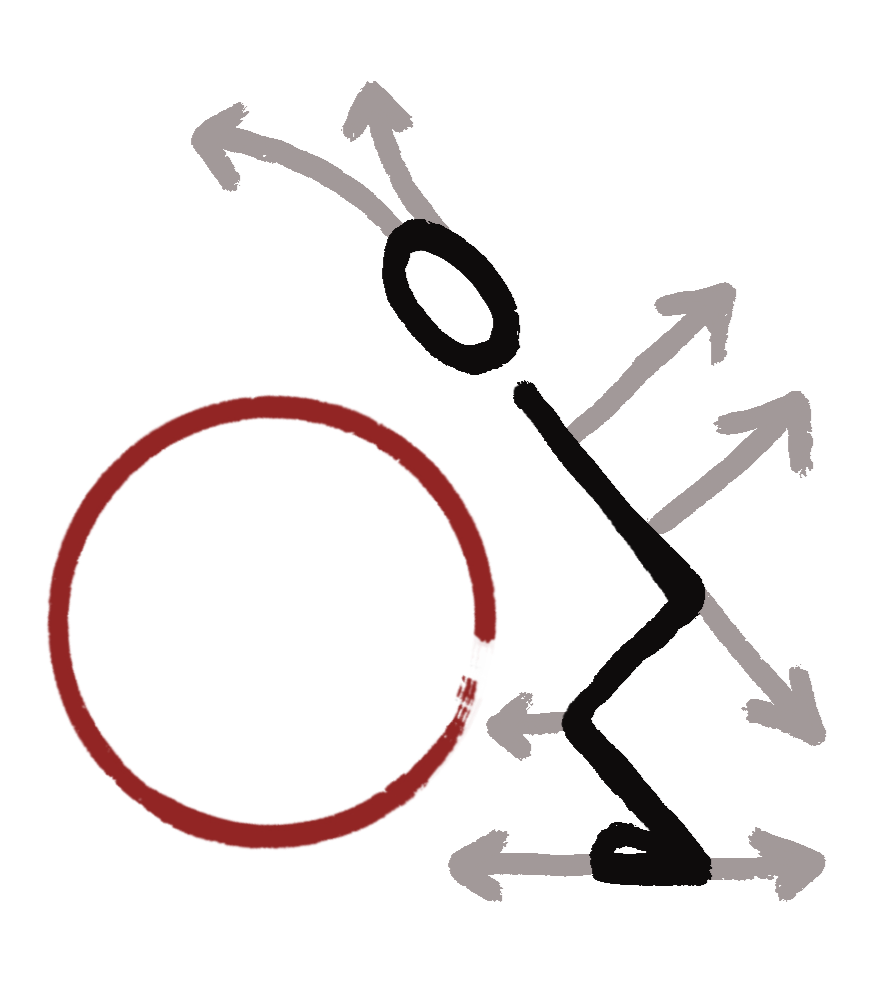
When he practiced ‘inhibiting’ or preventing the retraction of the head F.M. noticed an additional benefit—as his spine was less compressed, his back appeared to both lengthen and widen and his limbs acquired a quality of moving with more freedom and grace. In general, to those who observed him, he appeared to have greater vitality and better health.
Alexander’s work involves the use of mental orders or directions which are connected to our spatial thinking, awareness and balance.
Establishing the Alexander Technique
F.M. began to receive requests to teach his method to others who were either looking to improve their performance or ‘use’, or those who were struggling with certain chronic health issues. In 1904, he moved to England carrying endorsements from doctors in Australia. He soon established a successful teaching practice there. He also spent extended periods in the United States during the First and Second World Wars. After working with a few apprentices, he began his first formal teacher training course with a small group of students in 1931. His students, particularly Patrick MacDonald, Marjory Barlow and Walter Carrington, along with others, continued teaching the work and training more teachers. The work is now established in many countries with teachers in private practice and many teaching in performing arts programmes and conservatories. Among those who have practiced the Alexander Technique are George Bernard Shaw, John Dewey, Aldous Huxley, William Hurt, Moshe Feldenkrain (originator of the Feldenkrais Method), and others.